
After a fantastic Apple Weekend, when our team chatted to so many people about the varied and interesting fruit tree varieties we have in stock, we wanted to put together some information on our pick of the crop for this season.
Rootstocks
Before we delve into the specific varieties, we’ll touch on rootstocks and the difference they’ll make to your tree. There are two main questions we need to answer when deciding on the right tree for our gardens. What fruit do we want, and how big do we want the tree to be?
There are approximately 2,500 varieties of apple trees in the UK alone, and the variety of the tree determines the fruit, whereas the rootstock determines the size of the tree when mature.
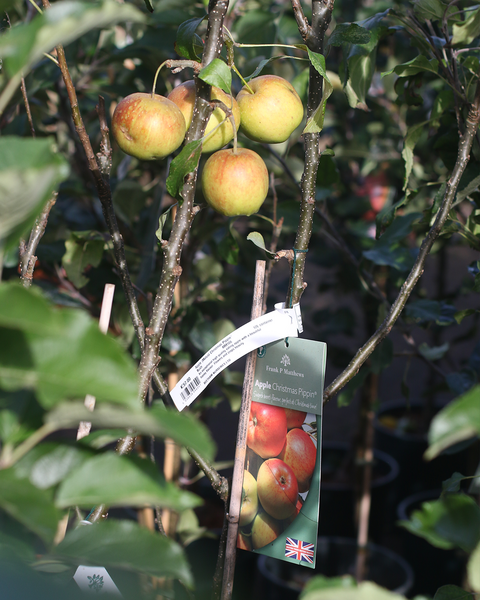
Our fruit trees come from the renowned grower Frank P Matthews, who hand-grafts each of their trees to control their growth habits and make them compatible for your space. The most popular rootstocks are semi-dwarf, or semi-vigorous, depending on whether you’d like a compact tree, for smaller gardens, or a larger tree, for larger gardens or orchards. When you come in to select your fruit trees, each tree has a useful label which explains the variety and rootstock, and our team will be able to guide you to the right variety for your space.
Apple Bramley 20
Everyone knows a Bramley apple. With arguably the best reputation for a cooking apple, Bramley trees are equally as prolific for being very large, vigorous, and spreading. Enter Bramley 20. This variety is a compact version of the very well-known Bramley’s Seedling and was developed in Bristol in the 1970s. Whereas the original Bramley trees can grow very large, Bramley 20’s compact form allows Bramley apples to be grown in any size space. Bramley 20 has an exceptional sharp flavour and produces a delicious puree when cooked. Fruits are a pale green flushed red or orange. Pure white, cup-shaped blossom arrives in late spring. We highly recommend this cooking variety for the smaller garden!
- Pollination group 3
- Uses: Cooking & juicing
- Picking month: Early October
- Pollination Partners: Charles Ross, Christmas Pippin, Fiesta.
Apple Charles Ross
Parentage: Peasgood’s Nonsuch x Cox’s Orange Pippin
This well-known garden and exhibition variety was raised at Welford Park Gardens in the 1800s and, after a spell of being exhibited as 'Thomas Andrew Knight', it was renamed in 1899 after the nurseryman who raised it. As well as being a very attractive apple, it has proven hardy enough for our Cumbrian climate. Its fruit is green-yellow, with an orange-red flush, distinct bright red stripes, and a sweet, juicy flavour and creamy white flesh. A good dual-purpose apple, Charles Ross is delicious when eaten straight from the tree and also bakes very well, keeping its shape and flavour.
- Pollination group 3
- Uses: Eating, juicing and cooking
- Picking month: Late September
- Pollination Partners: Christmas Pippin, Eden, Herefordshire Russet, Howgate Wonder
Apple Katy
Katy is a very attractive, early dessert apple. Firm and juicy, with a fine-texture and a pleasant strawberry-like flavour, the fruit is a bright scarlet with flecks and broken stripes of deeper colour. It makes excellent fresh juice, a palatable cider and is also good for baking into a delicious apple crumble. You can rely on Katy for heavy and regular cropping, and it’s also an excellent pollinator variety. Another good choice for Cumbrian gardens.
- Pollination group 3
- Uses: Eating, juicing and cooking
- Picking month: Late September
- Pollination Partners: Charles Ross, Christmas Pippin, Discovery, Fiesta, James Grieve
Apple Keswick Codlin
This variety has an unusual backstory, as it was found in Gleaston Castle near Ulverston on a rubbish tip in 1793. An old, heavy-cropping, early cooking apple, Keswick Codlin is pale green-yellow with a creamy white, tinged green flesh that's soft and has an acid-like flavour. An excellent eater and cooker for tarts and pies, the fruit cooks to a juicy cream froth and a purée which hardly needs sugar, making it excellent for jelly and butter. A profuse flowerer, with very heavy crops, the healthy trees are resistant to scab and mildew. Again, a great choice for Cumbrian gardens and orchards. The name is derived from 'coddle' or parboil, which is a process used to retain the apples shape when cooking, and the fruit was also an ingredient in the national dish 'codlins and cream'.
Pollination Partners: Adam's Pearmain, Bardsey, Egremont Russet, Howgate Apple Golden Pippin Apple Lord Lambourne Apple Red Windsor Apple St Edmund's Russet
- Pollination group 1
- Uses: Eating and Cooking
- Picking month: Early August
- Self-fertility: Self-fertile
Apple Legacy
Legacy is a special new apple tree released to mark Frank P Matthews’ 125th Anniversary, celebrating its heritage while supporting a meaningful cause, with proceeds donated for each tree sold to the National Garden Scheme Charity. This special apple is a highly attractive colour and is a natural mutation of the highly regarded Pinova apple, which is renowned for disease resistance, annual productivity and long natural home storage. The firm and snappy crunch, with a sweet, citrus-toned flavour, is very pleasing to apple lovers. The compact growth habit is ideal for gardens, and its attractive flowers ensure a full crop every year. One of the most unique characteristics is that the apples hang on the tree nearly all winter (up to mid-January), so owners do not have to find space to store apples, and can enjoy fresh fruit from the tree nearly all winter.
- Pollination group 3
- Uses: Eating and Juicing
- Picking month: Early October
Apple Eden
Eden is a dual-purpose, non-browning apple, with a delicious, crisp, sweet and aromatic flavour, similar to the popular apple Spartan. Eden behaves like Bramley when cooked, producing a snow-white puree needing no added sugar. This variety is also excellent for juicing!
Pollination Partners:
Apple Bountiful Apple Braeburn Apple Cox Self Fertile Apple Egremont Russet Apple Discovery Apple Ellisons Orange Apple Fiesta Apple Gala
- Pollination group 3
- Uses: Eating, juicing and cooking
- Picking month: Early October
Cherry Summer Sun
Summer Sun’s fruits are red to dark red, and firm and crunchy with an exquisite flavour. A very hardy variety, Summer Sun and produces crops even in unfavourable areas, and its good bushy shape makes the tree easy to manage. It sets fair crops on its own, but you’ll enjoy a more bountiful crop if it's pollinated by any other self-fertile variety.
- Pollination group 3
- Uses: Eating
- Picking month: Mid-July
- Self-fertility: Not self-fertile
Plum Guinevere
Guinevere is a healthy, well-shaped and manageable tree that produces a large, heavy-cropping plum that is black in colour and has sweet, yellowish flesh. Fruits are of excellent quality, appear from late September, and are long-lasting when fridge-stored. Overall, an excellent, delicious dessert plum, Guinevere is disease-resistant and easy to grow.
- Pollination group 3
- Uses: Eating
- Picking month: Late September
Pear Nuvar™ Misty Rose™
A cross between Concorde and Red Williams, the fruit of Misty Rose changes from purple to rose-pink at harvest time. Ripening in early October, fruit will store until Christmas and develops a juicy, melting texture and a flavour similar to Red Williams. A naturally small and compact tree, this variety is great for smaller spaces and patio growing. The red pear crops from an early age, and much more heavily than other red pears.
- Pollination group 3
- Uses: Eating and Juicing
- Picking month: Early October
- Self-fertility: Not self-fertile
Pollination groups
Before you make your final decision on a fruit tree, make sure you have the right setup for pollination. Most fruit trees — especially apples, pears, and many plums — cannot set fruit using their own pollen. Insects like bees must transfer pollen between two different varieties of the same fruit species, as an apple tree can only pollinate another apple tree. Because a tree can only be pollinated when its blossoms are open, matching the flowering times using pollination groups is essential.
Self-fertile trees can produce fruit on their own without a partner. However, even self-fertile trees yield much larger and more reliable crops if a second tree from the same or an adjacent pollination group is nearby.
Triploid varieties, such as the Bramley apple, have a genetic quirk that makes their pollen completely sterile. They cannot pollinate any other tree. If you grow a triploid, you actually need two other compatible, non-triploid trees nearby — one to pollinate the triploid, and another to pollinate the helper tree.
Fruit trees at Beetham Nurseries
Beetham Nurseries has a large selection of Frank P Matthews apple and fruit trees in stock, and our helpful team is always open to answering any questions, to help you decide on the right variety for your space.
With thanks to Frank P Matthews for information provided on the fruit tree varieties featured in this article. We’re proud to stock their UK-grown trees and appreciate their knowledge and passion for growing quality fruit trees.